Renovating in the Washington-Willow Historic District: What to Know
A 37-acre neighborhood listed on the National Register since 1980, with a Civil War-era house at its center — here's what renovating a home there actually involves.
ReadFayetteville, AR guide
Northwest Arkansas is building faster than almost anywhere in the country right now. Here's what that means for sizing and scheduling a dumpster on a Fayetteville new-construction job.
Northwest Arkansas isn't quietly growing — it's growing in a way regional planners are actively scrambling to keep pace with. A May 27, 2025 report commissioned by the Walton Family Foundation, "Our Housing Future: A Call to Action for Northwest Arkansas," found that median home prices across the region have climbed nearly 71% since 2019 — a steeper run-up than either Austin, Texas or the Durham–Chapel Hill area of North Carolina saw over the same stretch. The same report found the region's need for income-restricted rental units has grown from an estimated 7,100 households in 2019 to roughly 9,300 today, and that nearly 29,756 area households are now considered "cost-burdened," a figure up about 10% since 2019. None of that is abstract for anyone building or renovating here — it's the backdrop for why Fayetteville construction sites, from single-lot infill projects to full subdivisions, are busier than they've been in years.
Fayetteville's own development pattern has been shifting, too. City planning staff, in 2025 reporting, described a real move away from greenfield sprawl and toward infill development — smaller homes and townhomes built on vacant lots inside the city's existing footprint rather than on the edge of town. That shift comes with friction: one cited four-unit townhome infill project needed 17 separate code variances just to get approved, a good illustration of both how much appetite there is for this kind of building and how much regulatory navigation it can take to get there. At the same time, larger new subdivisions are still very much part of the picture — Brooklands at Mountain Ranch, a subdivision under construction in west Fayetteville, was reported on and photographed in local coverage in March 2025 as an example of the kind of greenfield project still moving forward alongside the infill trend.
If you're building in Fayetteville, it's worth knowing that the city itself has acknowledged its permit review process has been running slower than peer cities — average residential permit review timelines were cited at roughly 20 to 40 days, compared with 3 to 5 days in some comparable cities. The Mayor set a goal in 2025 to cut that wait by roughly a third by adding engineering and development-services staff. Whatever the current state of that timeline is when you're reading this, the practical lesson holds: build in some schedule cushion between when you expect approval and when demolition or framing debris will actually start hitting a dumpster, and don't assume a permit-driven delay means your container needs to sit empty and idle the whole time — a short-term pickup and later re-delivery is often the better call.
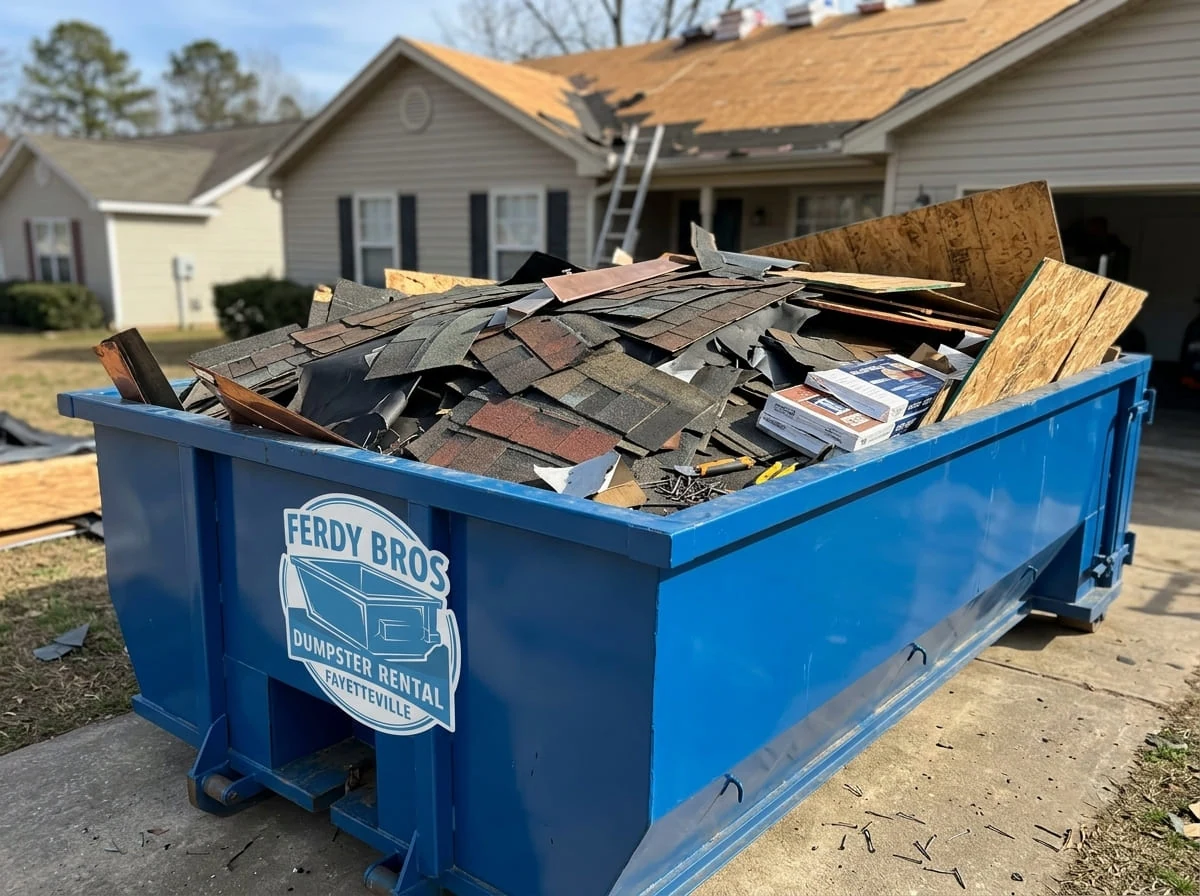
New-construction debris behaves differently than remodel debris. Framing offcuts, packaging, and general construction scrap are bulky but relatively light, while foundation work, masonry, and tear-off material from an infill lot's prior structure run heavy fast. Most new-build jobs in Fayetteville end up sized around the larger end of what we run:
| Size | Dimensions | Capacity | Weight included | Best for |
|---|---|---|---|---|
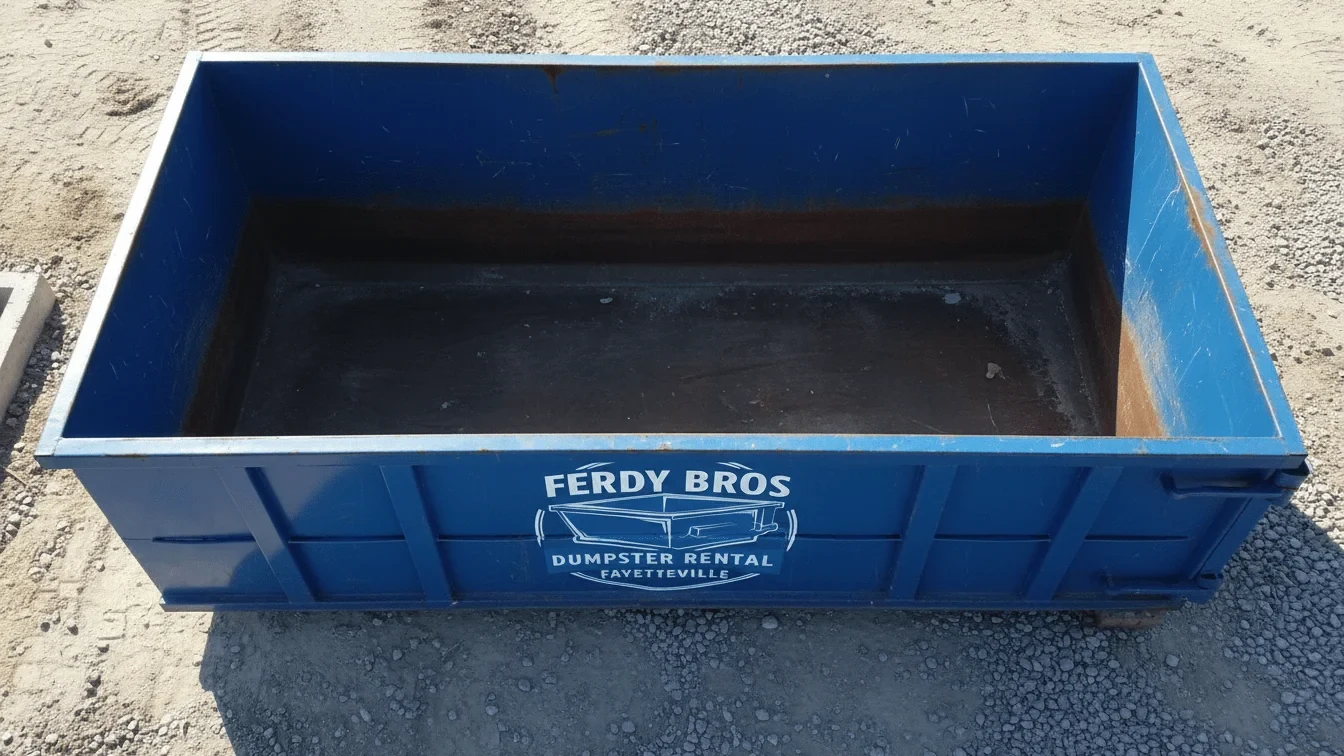
| 10 Yard Dumpster | 14 ft long × 7.5 ft wide × 3.5 ft high | about 3 pickup truck loads | 1–2 tons | Small cleanouts, yard debris and tight-driveway jobs — holds roughly 50–70 bags of debris. |
| 15 Yard Dumpster | 16 ft long × 7.5 ft wide × 4.5 ft high | about 4–5 pickup truck loads | 2–3 tons | Bathroom remodels, flooring removal and light renovations — holds roughly 80–100 bags. |
| 20 Yard Dumpster | 22 ft long × 7.5 ft wide × 4.5 ft high | about 6 pickup truck loads | 3–4 tons | Medium remodels, roofing jobs and construction debris — holds roughly 110–130 bags. |
| 30 Yard Dumpster | 22 ft long × 7.5 ft wide × 6 ft high | about 9 pickup truck loads | 4–5 tons | Whole-home cleanouts, large renovations and commercial use — holds roughly 170–190 bags. |
| 40 Yard Dumpster | 22 ft long × 7.5 ft wide × 8 ft high | about 12 pickup truck loads | 5–6 tons | Major construction, demolition and large-scale cleanups — holds roughly 230–250 bags. |
For a full subdivision build like Brooklands at Mountain Ranch, a 30 or 40 yard is typical for the framing and finishing phases, while a smaller infill lot clearing an older structure first often needs a 20 or 30 yard for the demolition phase and a separate container for framing scrap later. Either way, matching the container to the phase — rather than trying to make one size cover the whole project — is usually the more efficient call.
Whether you're a builder working a subdivision lot, a contractor tackling an infill project that took 17 variances to approve, or a homeowner adding on to a lot that's been in the family for years, the underlying story is the same: Fayetteville is building through one of the fastest growth stretches in its history, and debris logistics are part of getting a project done on schedule. Call and tell us what phase you're in and where the lot sits, and we'll get a container there sized for the work in front of you, not the whole project at once.
Talk to a real person
Call and describe the job. Flat price, stated tonnage, and a delivery time on the same call.
Mon–Sat 7:00am – 6:00pm
From this guide
It depends on the phase — demolition of an older structure on an infill lot often calls for a 20 or 30 yard, while framing and finishing scrap on a subdivision build like Brooklands at Mountain Ranch usually runs toward a 30 or 40 yard. Call and describe the phase and we'll size it.
It can affect timing more than size. If your start date is uncertain because of permit review, tell us when you call — we'd rather schedule delivery around a confirmed start than have a container sitting idle on a lot.
Yes — regional reporting and a 2025 Walton Family Foundation-commissioned housing study both point to a genuine building boom across Northwest Arkansas, with the city's own planning staff describing a real shift toward infill development alongside continued subdivision growth.
Yes — we deliver to jobsites across Fayetteville and Washington County throughout every phase of a build. Call (479) 396-3869 with the site address and we'll work out access and placement.
Keep reading
A 37-acre neighborhood listed on the National Register since 1980, with a Civil War-era house at its center — here's what renovating a home there actually involves.
ReadWith record fall-2025 enrollment above 34,000, UA's move-out season creates one of the biggest predictable debris spikes in Fayetteville every year. Here's how to plan around it.
ReadTwo separate facilities handle where Fayetteville-area debris actually ends up. Here's what each one is, where it is, and when it's open.
Read